Meet….Union Photographic!
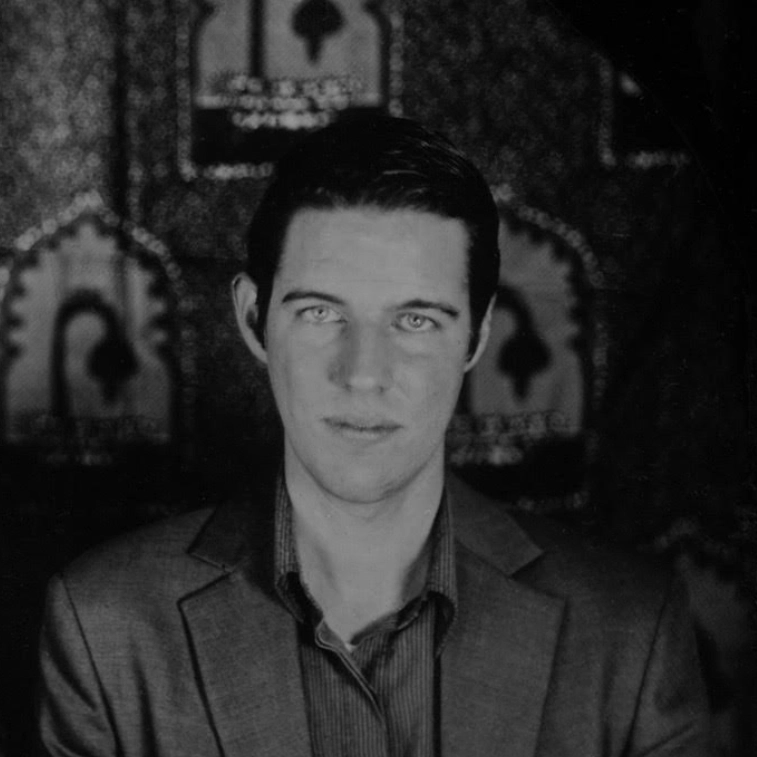
I’m Shelby Wright, and I make images using the historic wet plate collodion process under the business name Union Photographic.
I only hung my shingle mid-last year as a professional, but have been doing wet plate for almost five years now.
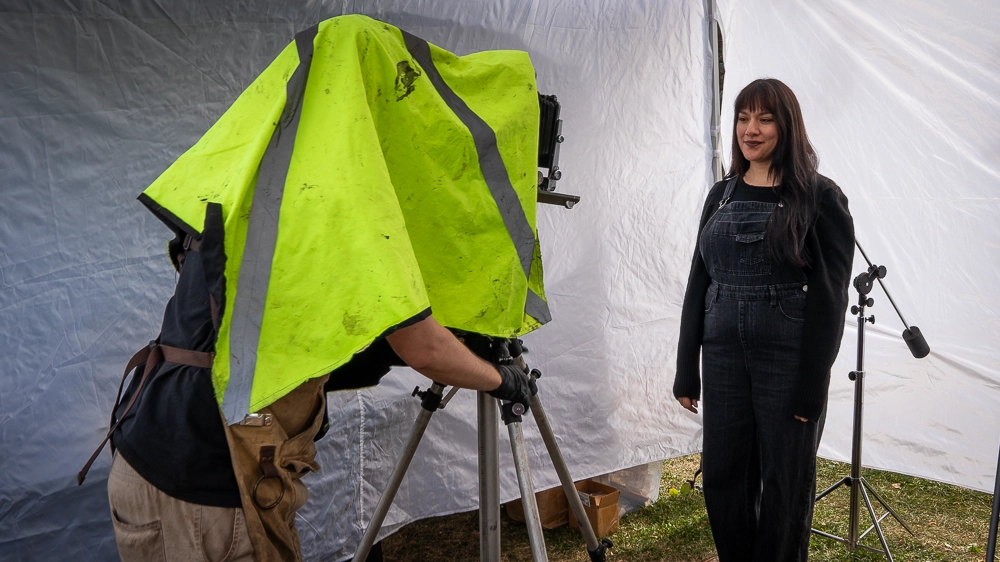
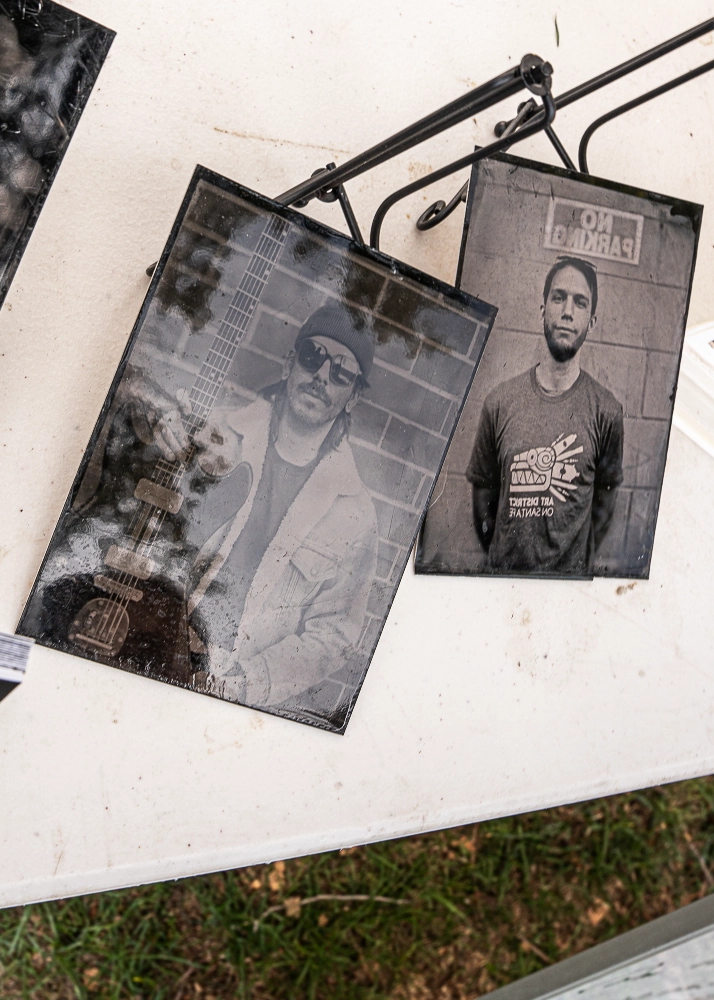
For pop-ups I mostly do tintypes, which are collodion images on metal.
Most people are used to snapping a picture with their phone, but this process is far from that. Tell us more about the work that goes into this type of photography!
You start by taking a glass or metal plate and pouring a syrupy mixture called collodion onto it, which is used to keep some added bromide and iodide salts in suspension. The coated plate is then immersed in a solution of silver nitrate, which in about three minutes reacts with those bromide and iodide salts to convert them into silver bromide and silver iodide, which are sensitive to light. The sensitized plate is loaded into a holder in a darkroom under a red safelight, taken out to the camera, and exposed. After that you need to get it back to your darkroom to develop before the plate dries out, which is about 10-15 minutes in Colorado.
After developing, the image looks like a negative with the shadows and highlights inverted, but putting it into a solution called fixer causes the unexposed silver to be pulled into the solution, making it reverse into a positive in a few seconds…it’s definitely the most magical part of the process to watch. The fixer makes the image no longer vulnerable to light, but then needs to be rinsed out for a while under running water. After that the plate is dried and then heated so that a coat of varnish can be applied. Once varnished it should remain archival for centuries.
There’s a lot of other little things that go into producing clean, well-exposed plates, but that’s basically it!
Were you a photographer before attempting this process? Tell us about your journey to arriving at your business.
Not professionally, but photography’s been a major through-line for me for pretty much my entire adult life. The pendulum has swung back and forth between film and digital over that time and I always wanted to try wet plate just out of an interest in history, the hands-on nature of it, and the sheer cussedness of wanting to do things the “hard way”.
Back in Australia, I was finally living in one place long enough it made sense to get all the chemicals together and have a crack at it. My first efforts were pretty bad but even that first vague, muddy image was really exciting, holding a tangible image/object in my hands that I’d made myself. From there I was fortunate enough to link up with another guy locally who really knew the process and was happy to share his expertise in exchange for using my chemistry and portable darkroom when we were out.
As far as the business side of things, I’ve always enjoyed photography and found it really interesting, but I don’t think I ever really felt excited enough about it to feel the need to share it like this until I got into wet plate. By nature I’m someone who tends to do a lot of research first and over-prepare, but what I found is that while a lot of basic advice that applies to running a business also applies to this process, there are enough elements that are unique to where I was coming up with more questions than answers.
I realized I was chasing my tail and finally sat down with a blank Google Doc and said “OK, what’s the minimum I need to set up as a business?”, and since my obsession had already left me pretty well-equipped with chemistry and equipment it actually turned out to be a very short list. I’d read some of Chris Guillebeau’s books (“Side Hustle” and “The $100 Startup”) and realized that even though the business model was unproven, in my situation I could start small and use that experience to learn and refine what I was doing.
I wouldn’t say there have been any major revelations in my first year, but I’ve definitely been making steady progress and have some more firmly-defined directions I want to take things in over the medium and long term. As someone without much entrepreneurial experience up until now it’s been amazingly refreshing; if I have an idea I can just… try it and see if it works, without having to get anyone’s permission.
What has it been like offering this at markets? Any standout moments?
I’ve been pleasantly surprised at the interest; I’ve done very little promotion (not something I’m proud of – is a goal to learn for 2026!) so typically people are coming across me and deciding “sure, I’ll get a 19th-century portrait taken” in the moment, which is pretty wild when you think about it. While I can’t deny there’d be some nice creature comforts working out of a brick and mortar studio, one of the things I enjoy most about the process is bringing it out into the world where people can just kind of stumble across it and pop-ups offer a great opportunity to do this.
Doing pop-ups is definitely not something I’d recommend to someone just starting out in this process; you have to really have your process and chemistry knowledge down to be able to troubleshoot issues on the fly, all while talking with customers. Coming from a teaching background originally, being able to multi-task and break down unfamiliar concepts to groups of strangers have also been really useful skills to have. People are usually really curious about the process and getting to talk about it all day is one of the perks of the job, IMO.
In addition to the market-goers, I’ve really gotten to enjoy knowing some of the other vendors (shout out to AFEVE-R-DREAM, Disco Studio Polaroids, Brass Wolf Workshop, and others)! Because you can’t really use a light meter to figure out your exposure the same way you can with film or digital, I typically start the day with a test plate to get a baseline exposure to work from. Most of the time, this is roping in a neighboring vendor who’s finished setting up and looks amenable. It also helps to keep the plate on display throughout the day to help passers-by make the connection that I’m taking the image on the spot (rather than developing them at home and mailing them like you’d expect with film), and I’ll finish off the day by varnishing it and giving it to the person to take home.
What’s something that people don’t always understand about getting a portrait done in this way?
To smile or not to smile! People really over-estimate how long they’re going to need to hold still – while the “several minutes” figure often cited in history books was initially true, within a few years advances in both chemistry and lenses brought this way down, to around 10-15s for the typical indoors portrait sitter.
People think that the Victorians didn’t smile because they didn’t think they could hold a convincing expression for that long, but it was actually more a function of cultural views of what a portrait should be. Back then, it was thought that the image should capture some kind of permanent “essence” of the sitter for posterity rather than any one particular mood or moment in time, so a neutral expression was typically preferred. Of course, having an image that looks “period” is often one of the draws for participating in the process, but I always encourage people to experiment and make the image their own, and not feel like I’m there to enforce “genre rules” or anything like that. I’m not a re-enactor, and one of the things that draws me to wet plate is making new work in an old medium, so I find the apparent contradictions interesting. Smile, leave your smartwatch on, wear your favorite band T-shirt… go crazy! 🙂
Is there anything you’re excited about or focusing on in 2026 with your work or business?
Quite a lot!
I started offering workshops at the Colorado Photographic Arts Center, which have sold out with full waiting lists! We are looking at adding some additional dates in early summer, so subscribe to their newsletter if you’re interested. If you don’t mind being out in nature, you can also get in touch with me directly if you want to set up a 1:1 or small group lesson.
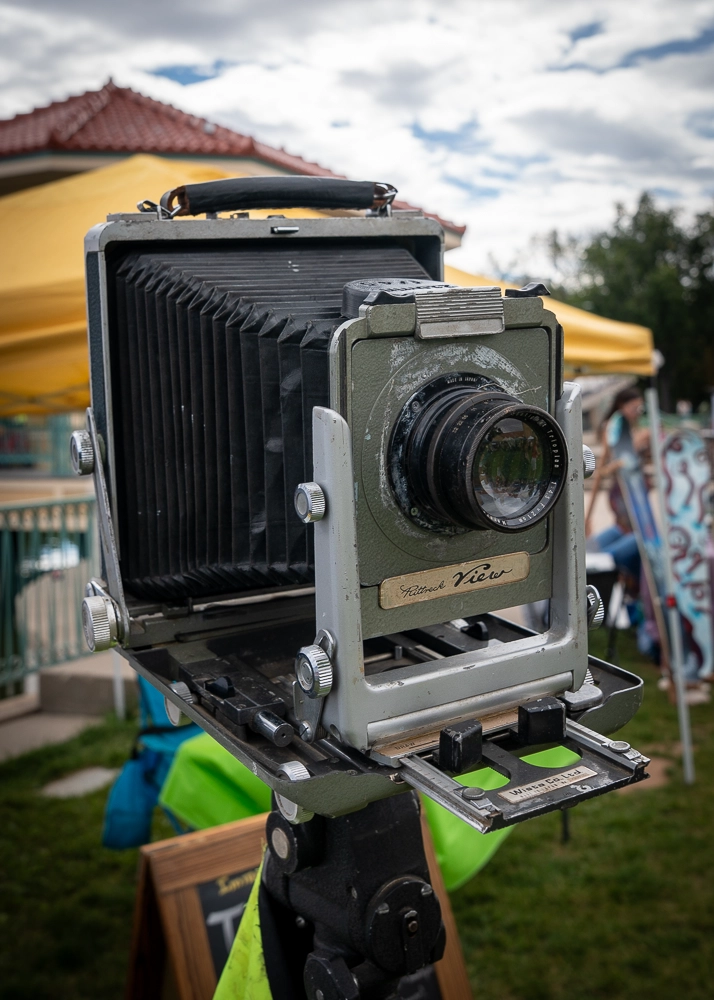
Aside from workshops, having taken a CNC laser class as part of my woodworking degree last semester, I’m also excited to start offering some tintypes engraved with custom frames (the anodized aluminum that most modern practitioners use for tintypes is actually originally made for laser engraving). For my final project in that class I also created a replica 19th century photo case using a combination of historic and modern construction techniques and materials, which has been a long-term goal of mine. These are a lot more niche and require a lot of work by hand so I’m not necessarily sure there’s going to be a lot of demand at the price I’d be offering them at, but I’m just really stoked to have something to further elevate the presentation of my work. Now that I have a better set of woodworking skills, I’m also looking at taking some directed study through my woodworking program earlier in the summer. There are a few pieces of equipment that have been in the design stage for a while, my “stretch goal” is actually to build a functioning replica 19th-century tailboard camera for events (I have the plans, but whether I can pull it off is another question). “How old is your camera?” is probably a top 3 question I get, and I really look forward to being able to say something like “about three months” and see the look on people’s faces, lol!
I also recently finalized arrangements for my first artist residency, so quite a lot of ‘it would be cool to…” experiments and projects have now become “I need to have this done by…’ overnight, and there are a lot of additional logistical things to figure out as far as chemistry, equipment, etc. I’ll be based just outside of Tokyo from mid-July to mid-August working on a few projects: some landscape and architecture work similar to what I was doing back in Australia, and also a more ambitious one trying to create some modern occupational portraits, which is an idea that has been percolating for quite a while now. I think the latter is going to be challenging without having a lot of local contacts and relationships (also, my Japanese is mid at best), so I’m hoping to lay some groundwork in the coming months, and also start building a portfolio of similar work here in CO that I can show people to hopefully get them on board.
Lastly, I’m also hoping to get out and do more landscapes here in Colorado – last year I got my feet wet with platinum/palladium printing and I’m keen to get out to the mountains and create more ambrotypes (collodion glass negatives) that I can print directly from. I’m really interested in the possibilities this opens up creatively, and one thing I’ve noticed at markets and other events is that given the nature of the process there’s definitely a finite number of portraits I can take in an afternoon, so diversifying my offerings a bit is going to be essential for scaling that side of the business.
Instagram is the best way to follow and keep updated on Union’s new work.
For direct enquiries you can always send him an email to [email protected].
And you can check out his portfolio and blog posts at his website!